Not seeing your business in ChatGPT recommendations? Explore five possible reasons and practical steps to improve visibility in AI search.
A business owner can spend years improving Google rankings and still wonder why their company never appears when someone asks ChatGPT for a recommendation. It is a reasonable question, especially as customers begin using AI assistants to research services, compare providers, and narrow their options before contacting anyone.
The short answer: your business may be missing because its services are not described clearly, relevant public sources are thin, or the question does not match its specialty. Before changing anything, test several real customer questions and compare the sources that appear. In Whitespark's 2026 Local Search Ranking Factors survey, experts rated curated best-of lists, dedicated service pages, and relevant industry mentions highly for AI visibility. These are expert opinions, not a disclosed ChatGPT ranking formula. Read the Whitespark research for the methodology.
The first thing to understand is that ChatGPT is not simply another Google results page. Depending on the query and product features, an answer may draw on model knowledge, current web results, or other available sources. Recommendations can vary by wording, context, location, and timing. There is no permanent number-one ChatGPT position that a business can purchase or lock in.
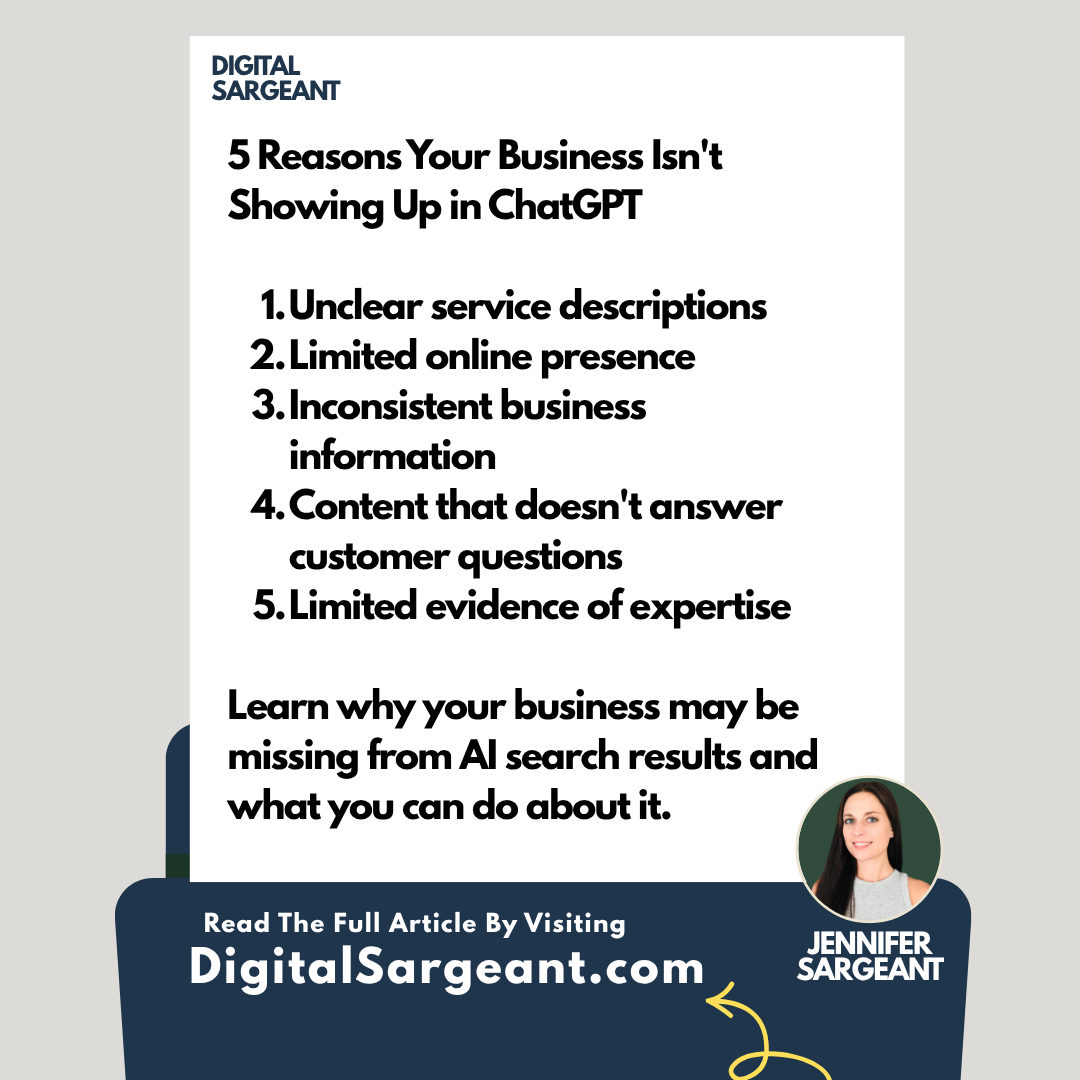
Your business may be difficult to identify:
If a website relies on phrases like 'innovative solutions' instead of clearly explaining services, specialties, customers, and service areas, both people and automated systems have less to work with. A useful homepage should answer what the business does, who it serves, where it operates, and why someone should choose it.Your online presence may be too narrow:
Your website is the foundation, but potential customers also encounter your company through relevant directories, professional organizations, articles, customer reviews, and industry websites. Independent mentions can help establish that the company exists and give search systems additional information to discover. They are not guaranteed AI ranking factors, and buying hundreds of weak listings is not a substitute for credibility.Your information may be inconsistent:
Outdated addresses, conflicting business names, duplicate listings, and stale descriptions make it harder for customers to recognize the same company across different sources. Audit your business profiles and correct inaccuracies before creating new citations.Your website may not answer the questions customers ask:
A list of services is useful, but it is rarely enough. Prospects want to understand your approach, what problems you solve, which situations are a good fit, and what to expect next. Original explanations, relevant examples, and detailed service pages give search systems more useful material to find and potentially reference.Technical barriers can limit discovery:
Important pages may be blocked by robots settings, inaccessible to crawlers, or missing from major search indexes. Check Google Search Console, review public-page accessibility, and confirm that your site is not unintentionally preventing relevant search crawlers from retrieving content.
What to do first
Start with a repeatable visibility check. Write down ten realistic customer questions, test them consistently, and record whether your business appears, whether the answer is accurate, and which sources are cited. Then prioritize clearer service pages, accurate business profiles, useful original content, and technical fixes. Treat the results as directional, not as a fixed ranking report.
A practical way to diagnose the problem
Begin with the actual services people buy, not a broad question like “What is the best business near me?” Imagine a homeowner searching for “an HVAC company that can replace an older system and explain financing options.” That question contains several buying criteria. If an HVAC contractor's website says only “heating and cooling solutions,” the page does little to establish whether the company handles replacements, serves that location, or offers financing. A better service page explains replacement options, the consultation process, financing availability if offered, and the geographic area served. This is useful to customers regardless of whether an AI tool references the page.
Try three categories of questions: broad discovery (“Who provides this service in my area?”), problem-specific discovery (“Who can handle this particular issue?”), and comparison (“Which providers offer these two capabilities?”). Test multiple phrasings and record the answers without repeatedly adjusting your question until your company appears. Include competitors only when they genuinely fit the same customer need.
What to inspect when competitors appear, and you do not
Look beyond the names in the answer. If the tool cites websites, open those sources. Does a competitor have a detailed service page that answers the question directly? Is its business category clearer? Has it earned coverage from an industry publication, professional association, or local organization? These are leads for investigation, not proof that a particular mention caused the recommendation. An AI answer can also omit a qualified business for reasons unrelated to its marketing quality. If you're trying to understand why a company appears in one answer but not another, the companion article How Does ChatGPT Choose Which Businesses to Recommend? explains why context and prompt wording matter.
Review your own homepage, two highest-value service pages, and contact information. Ask a colleague unfamiliar with your company to identify your services, location, ideal customer, and differentiators in under a minute. If that is difficult, improving clarity is a more defensible investment than publishing another generic blog post.
A 30-day improvement plan
In week one, document ten realistic buyer questions and establish a baseline across the AI products you want to monitor. In week two, correct inconsistent business information and verify that important pages can be accessed and indexed. In week three, rewrite one priority service page around real customer decisions, adding qualifications, process details, relevant examples, and answers to common objections. In week four, repeat the same tests and review website inquiries and lead quality. Do not treat a change in mentions over four weeks as proof of causation. The purpose is to build a repeatable process and improve the information customers can actually use.
The takeaway
A missing ChatGPT recommendation is a signal to investigate, not a verdict on your business. The most productive response is to strengthen the parts of your online presence that help a buyer understand and trust what you offer.
Want a second set of eyes on your website and AI search visibility? Book a call with Jennifer Sargeant to discuss where to focus first.