How to Choose an AI SEO Agency Without Wasting Your Marketing Budget
Learn what to ask an AI SEO agency, which promises to avoid, and how to choose a partner focused on measurable business outcomes.
AI search is attracting agencies, consultants, software vendors, and newcomers offering services under similar names. For a business owner, the challenge is not finding someone who uses the phrase 'AI SEO.' It is identifying a partner who understands search, can execute the work, and will be accountable for what is delivered.
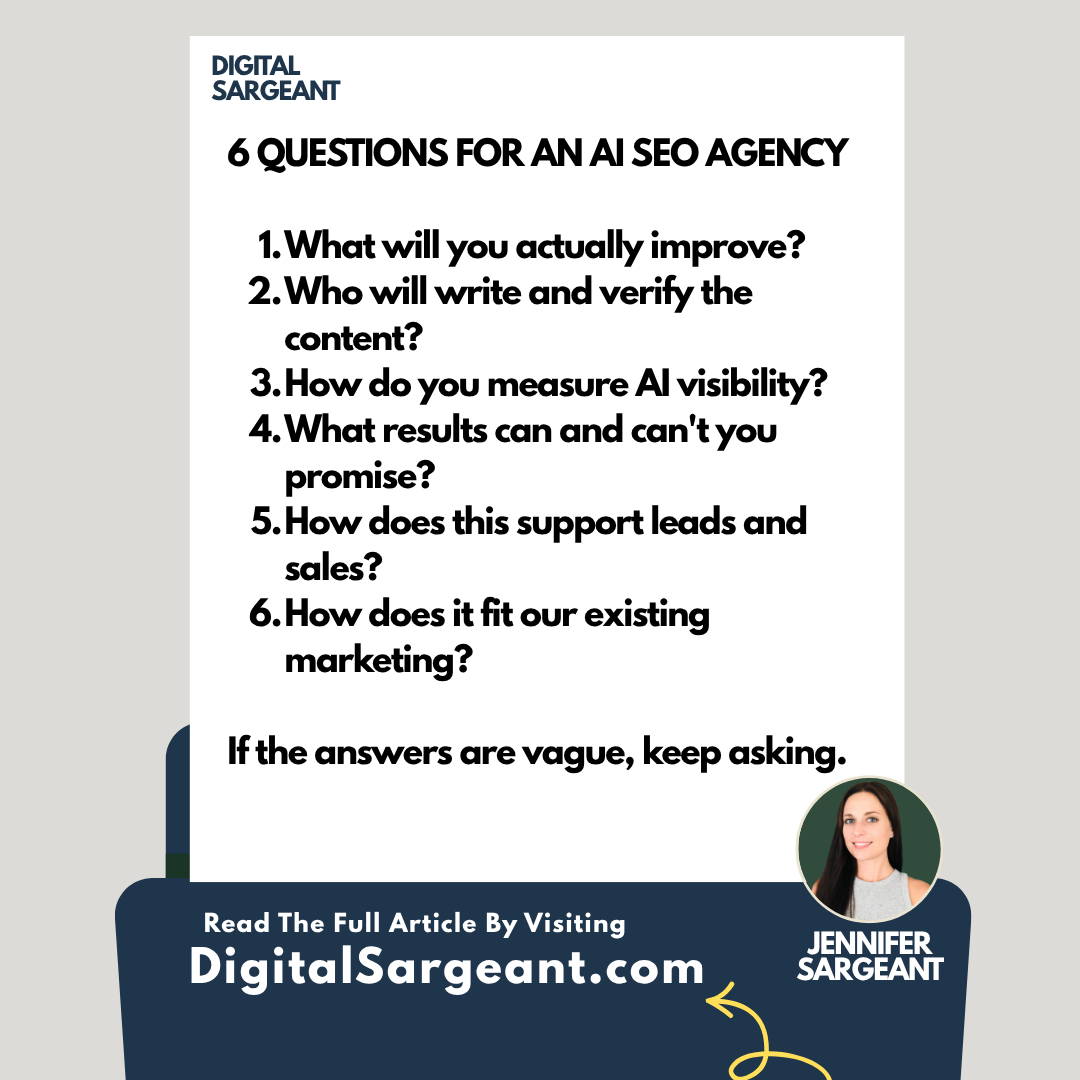
The short answer: hire an agency that can explain what it will change, who will do the work, how it will measure results, and what it cannot guarantee. Ask for a real example of an improved service page and a reporting sample that includes misses as well as favorable AI mentions. Whitespark's 2026 research points to both dedicated service pages and independent authority signals, so a proposal focused entirely on mass-produced blog posts should raise questions. Review the Whitespark research.
Ask what the agency will actually change
A strong proposal should identify the website pages, technical issues, business profiles, content gaps, and third-party opportunities that need attention. 'Optimize for AI' is not a deliverable. Clear tasks, owners, and priorities are.
Look for search and marketing experience
AI visibility does not exist in isolation. An agency should understand website architecture, traditional SEO, customer intent, analytics, content, and conversion strategy. If the plan creates traffic but no path to inquiries or sales, the business value is limited.
Request a measurement methodology
Ask which questions will be tested, which AI products are included, how often checks occur, and how response variability will be handled. Also ask how the agency will connect its work to qualified leads. A single screenshot of your company appearing in ChatGPT is not sufficient reporting.
Challenge guarantees
No agency can guarantee permanent organic placement in an AI-generated answer. Be skeptical of anyone selling a fixed 'number-one ChatGPT ranking' or claiming privileged access to recommendation algorithms.
Clarify content ownership and quality
Find out who writes the content, how claims are verified, and whether the agency uses your actual expertise and business experience. Mass-producing generic pages may create more publishing work without making your company more useful or distinctive.
Make sure the work fits your broader strategy
Your agency should know when AI search deserves attention and when the next dollar would be better spent fixing conversion problems, improving Google Ads, or strengthening core SEO. A good partner is willing to prioritize the highest-impact work, even when it is not the newest service.
Ask to see the actual process
An agency should be able to walk you through a sample engagement from discovery to implementation. What does it review first? How does it decide which pages need work? How are customer questions researched? Who verifies technical findings? Who writes and approves content? How are changes measured? Specific answers reveal more than a polished sales deck.
A strong first phase might include an audit of the company's core service pages, technical access, business profiles, and a fixed set of realistic AI search questions. The next phase should translate findings into prioritized tasks. For example, a contractor may need clearer replacement-service content and corrected service-area information before commissioning a dozen new articles.
Evaluate the writing, not just the tools
Ask to see a before-and-after example of a service page or a substantive educational article. Does the revised content explain the business more clearly? Does it answer questions a buyer would genuinely ask? Are qualifications, service boundaries, and examples accurate? An agency that relies on generic copy or invented claims can produce volume without improving credibility. Find out whether someone with relevant subject expertise reviews the work.
Understand how success is reported
Request a sample report showing the exact types of prompts tested, dates, AI products, source references, website work completed, and relevant business outcomes. The agency should explain the limits of AI visibility sampling and avoid presenting a few favorable screenshots as a universal ranking. Ask whether the report includes qualified inquiries, not just mentions.
Make ownership and access explicit
Your company should understand who owns the published copy, website assets, analytics accounts, and any tracking dashboards. Clarify whether the agency will work in your existing systems and what happens when the engagement ends. An optimization program should leave your business with better assets and clearer information, not a dependency on a proprietary score.
A practical comparison exercise
Give two prospective agencies the same hypothetical problem: your company has a strong Google presence but rarely appears in sampled AI answers for a specialized service. Ask each to outline its first 30 days. Look for a diagnostic approach, specific deliverables, and a willingness to investigate rather than guarantee an outcome. Favor the partner who can explain what it will change and why.
The right agency should also be willing to tell you when another investment comes first. If your lead intake is broken or your highest-value service page is confusing, fixing those issues may deliver more value than expanding an AI content calendar. For more detail on the factors that influence scope and pricing, see How Much Does AI SEO Cost for a Small Business?
If you are comparing AI SEO agencies and want a practical assessment of the options, book a call with Jennifer Sargeant to review your goals and proposed scope.